Acai bowl calorie labeling applies to a menu only for chains of 20 or more locations under one name, plus shops that register with the FDA. Specifically, the rule is 21 CFR 101.11, and it treats a bowl with a choice of toppings as a variable menu item. In short, this guide turns the rule text into a short checklist. It shows what to list, how to round and which two statements to print. However, it only summarizes a federal rule and is not legal advice, so confirm the details with the FDA and your local food-safety office.
Key Takeaways
- First, the rule covers chains with 20 or more locations under the same name, and shops that register with the FDA.
- Second, a bowl with toppings lists the basic bowl’s calories for each size. Then it lists each topping as added calories.
- Therefore, calories round to the nearest 5 up to 50 and to the nearest 10 above 50.
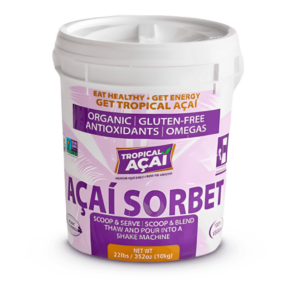
- Also, Tropical Acai labels give base values per 100 g: 80 calories for Organic Pure Acai and 110 for the Authentic Mix.
Table of contents
- Who Needs Acai Bowl Calorie Labeling?
- How Acai Bowl Calorie Labeling Treats Toppings
- Rounding and Format Rules for Calories
- The Two Statements Every Covered Menu Needs
- Self-Service Toppings Bars and Calorie Signs
- Written Nutrition Information on Request
- Where the Numbers Come From: A Reasonable Basis
- Acai Bowl Calorie Labeling Checklist: Seven Steps
- Acai Bowl Calorie Labeling FAQ
- Keep Exploring Acai Bowl Menus
Who Needs Acai Bowl Calorie Labeling?
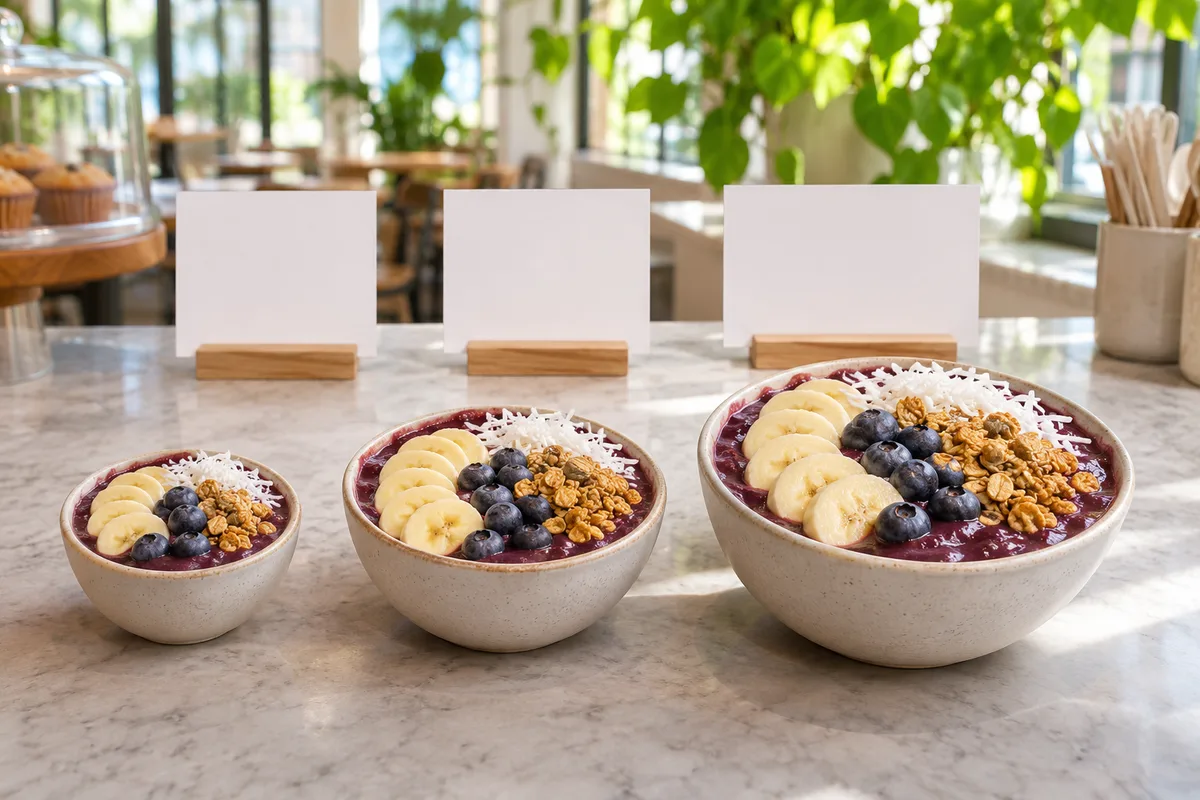
First, the rule defines a covered establishment. In short, it is a restaurant or similar retail food establishment in a chain of 20 or more locations doing business under the same name and offering substantially the same menu items. Franchises count too, whoever owns them. In other words, menu labeling for acai shops follows the same rule as for any other restaurant.
In contrast, the rule does not cover a single shop by default. However, a shop may register with the FDA on Form FDA 3757. According to the rule, a registered shop then drops out of non-identical state or local nutrition labeling requirements. In addition, a registered shop must renew every other year, within 60 days before the registration expires.
Next, some items fall outside the rule. For a bowl menu, four exemptions matter:
- Daily specials that a shop promotes for one particular day.
- Temporary menu items that appear on the menu for less than 60 days per calendar year.
- Custom orders, because a bowl the kitchen makes differently from usual at one guest’s request.
- Market tests, because the item stays on the menu for fewer than 90 consecutive days.
However, local rules can differ from the federal one. Therefore, ask your county food-safety office before you print a menu.
How Acai Bowl Calorie Labeling Treats Toppings
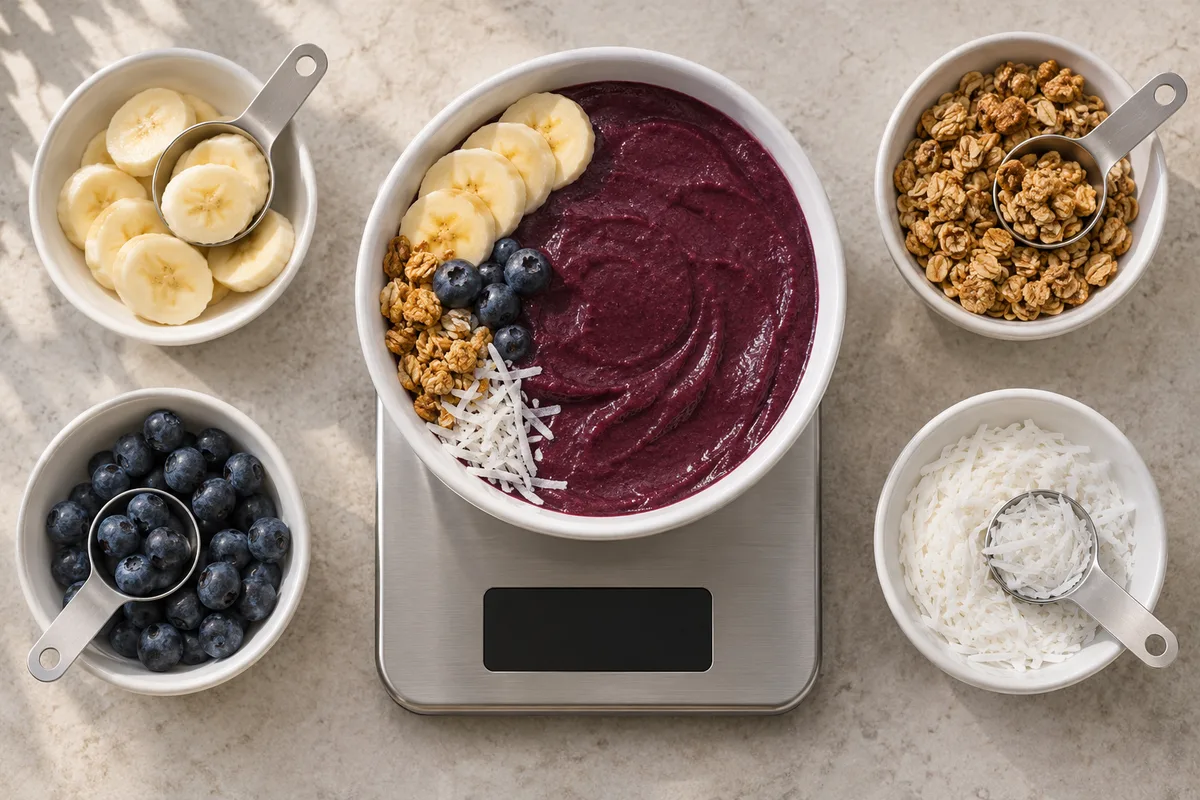
First, the rule calls a menu item with listed toppings a variable menu item. For a bowl, that means the menu shows the calories of the basic bowl for each size. Then it lists every topping on its own and states that the topping adds its calories to the basic bowl.
For example, the table below is a planning example of an acai bowl calorie count. The base values come from the Organic Pure Acai Packs label, which lists 80 calories per 100 g pack. Also, the topping values come from USDA FoodData Central, and we round them the way the rule asks.
| Menu item | Amount | Calculation | Menu line |
|---|---|---|---|
| Small bowl, Pure Acai base | 1 pack, 100 g | 80 per pack | 80 Cal |
| Medium bowl, Pure Acai base | 2 packs, 200 g | 2 x 80 | 160 Cal |
| Large bowl, Pure Acai base | 3 packs, 300 g | 3 x 80 | 240 Cal |
| Banana, sliced | 50 g | 89 per 100 g x 0.5 = 44.5 | adds 45 Cal |
| Blueberries | 30 g | 57 per 100 g x 0.3 = 17.1 | adds 15 Cal |
| Strawberries, sliced | 40 g | 32 per 100 g x 0.4 = 12.8 | adds 15 Cal |
Meanwhile, the Authentic Mix Organic Acai Packs label lists 110 calories per 100 g pack, because the recipe includes organic cane sugar. Therefore, the same ladder reads 110, 220 and 330 Cal. As a result, the base you choose changes every size on the menu.
Slash and Range Rules for Different Sizes
However, calorie labeling for toppings changes with size. If a topping adds a different amount on each size, declare it for each size. For instance, with two sizes, the rule allows a slash, as in its example “adds 150/250 cal”. With three or more sizes, however, it allows a range, as in “adds 100-250 cal”. In both cases, the menu must say that the difference comes from the size of the bowl.
Rounding and Format Rules for Calories
The numbers on the menu must follow a strict format. Specifically, here is what the rule asks for each calorie declaration:
- Round to the nearest 5 calories up to and including 50, and to the nearest 10 calories above 50. A shop may list amounts under 5 as zero.
- Next, print the number next to the item name or its price, and use a type size no smaller than the smaller of the two, in the same color or a more conspicuous one.
- Then use the word “Calories” or “Cal”, either as a column heading or beside each number.
- Finally, for two options, separate the numbers with a slash, as in “150/250 calories”. For three or more, print a range in the form “100-250 calories”.
Also, rounding changes the numbers you print. For example, 44.5 calories of banana becomes 45, while a 160-calorie medium base stays at 160. Therefore, calculate from the exact label values first, and round only the final menu line.
The Two Statements Every Covered Menu Needs
First, a covered menu carries two fixed sentences. The first reads: “2,000 calories a day is used for general nutrition advice, but calorie needs vary.” The second reads: “Additional nutrition information available upon request.”
On a printed menu, the first statement goes at the bottom of each page. Then the second goes at the bottom of the first page with menu items, beside the first. Likewise, on a menu board, both go at the bottom of the board. Also, both must be at least as large as the smallest calorie number and at least as conspicuous in color.
Self-Service Toppings Bars and Calorie Signs
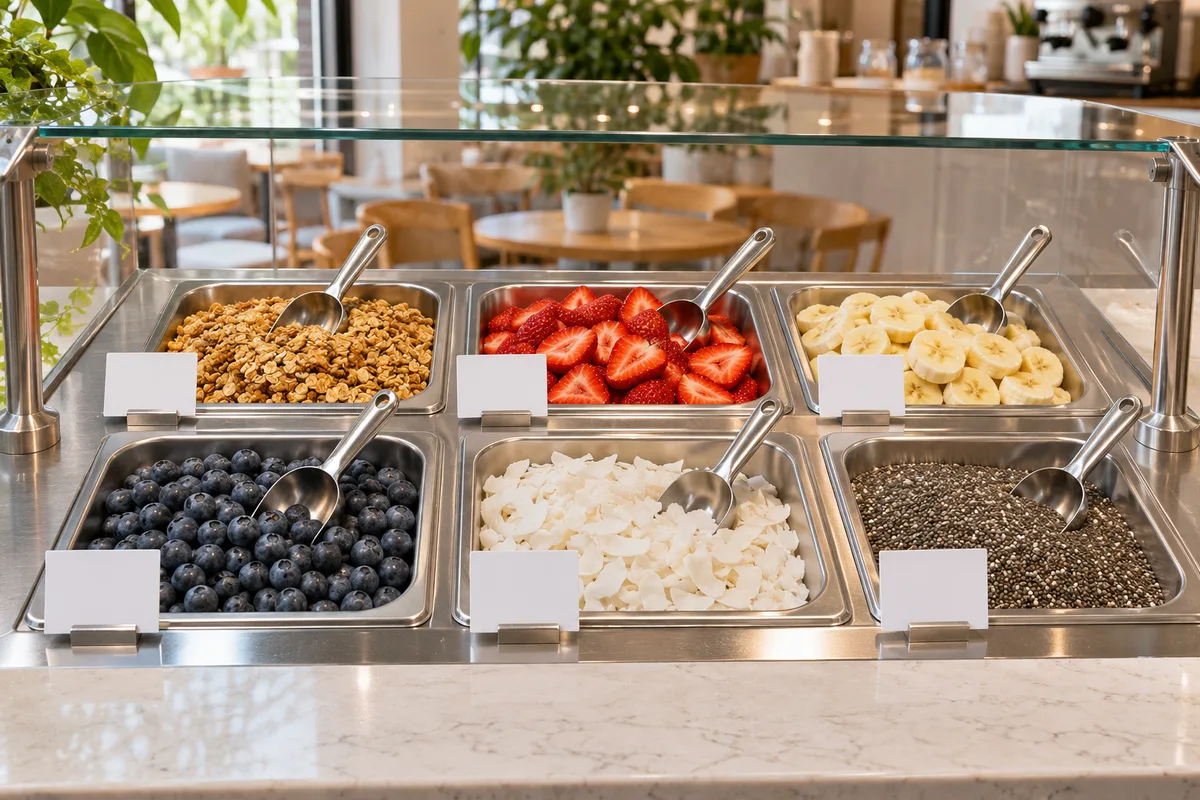
First, a toppings bar counts as self-service food. For it, the rule asks for a sign next to each food that gives calories per serving and names the serving unit. The rule’s own wording example is “150 calories per scoop”.
Next, the serving instrument must dispense a uniform amount, such as a scoop or a ladle. In short, one fixed scoop does two jobs: it sets the portion and it backs the number on the sign. For example, a level scoop of granola gets one fixed number. To learn the weighing routine, read our guide to acai bowl portion size.
However, some bars have no clear upper limit on what a guest can add. In that case, the rule asks the menu to say “See buffet for calorie declarations” next to the item’s name or price.
Written Nutrition Information on Request
Calories on the menu are only the first layer. In addition, the rule requires written nutrition information on the premises, and a guest can ask for it. Specifically, it lists eleven values, in this order: calories, calories from fat, total fat, saturated fat, trans fat, cholesterol, sodium, total carbohydrate, dietary fiber, sugars and protein.
Also, for a variable item, the sheet shows the basic bowl and each topping separately, for each size. For the base, the table shows the values that Tropical Acai prints on its labels.
Tropical Acai Base Values per 100 g
| Per 100 g | Organic Pure Acai | Authentic Mix Acai | Organic Acai Pulp Base |
|---|---|---|---|
| Calories | 80 | 110 | 110 |
| Total fat | 7 g | 7 g | 4 g |
| Saturated fat | 2 g | 2 g | 0 g |
| Sodium | 35 mg | 25 mg | 10 mg |
| Total carbohydrate | 3 g | 12 g | 17 g |
| Dietary fiber | 3 g | 3 g | 3 g |
| Added sugars | 0 g | 9 g | 14 g |
| Protein | 1 g | 1 g | 1 g |
Specifically, these values belong to the Organic Pure Acai Packs, the Authentic Mix packs and the Organic Acai Pulp Base. However, for nutrients the label does not print, such as cholesterol, use the topping’s own label or a database. For a wider comparison of formats and labels, see our guide to acai and pitaya formats.
Where the Numbers Come From: A Reasonable Basis
First, a covered shop must have a reasonable basis for every number it prints. Specifically, the rule accepts nutrient databases, cookbooks, laboratory analyses and other reasonable means. In fact, it names Nutrition Facts labels on packaged foods that meet federal labeling requirements as one of those means.
Therefore, for a bowl, that gives a simple split. First, take the base from the Tropical Acai label. Then take each topping from its own package label or from USDA FoodData Central, where raw bananas list 89 calories per 100 g, raw blueberries 57 and raw strawberries 32.
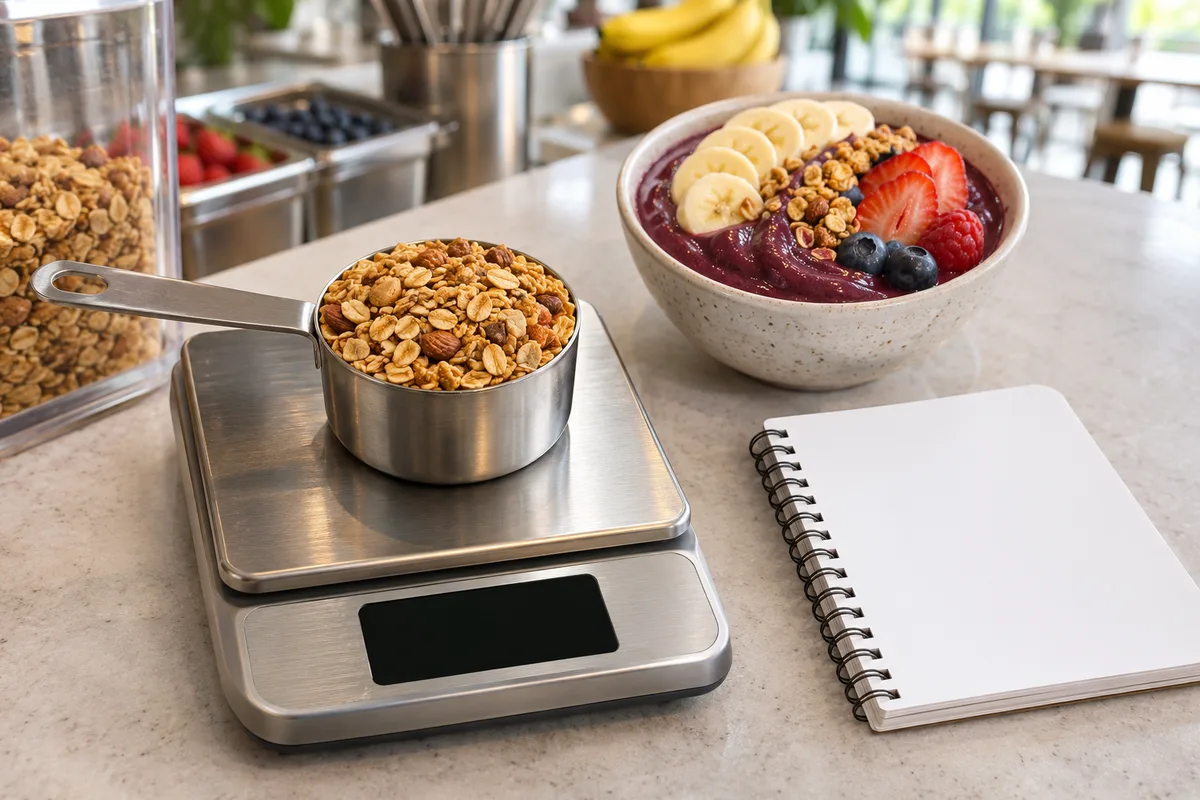
Accuracy also depends on the kitchen. For example, the rule asks a shop to take reasonable steps so that the ingredients and amounts it serves match the factors behind its numbers. Therefore, a scale and fixed scoops matter as much as the spreadsheet. Finally, if the FDA asks, the shop must provide the method and the data behind each value.
Acai Bowl Calorie Labeling Checklist: Seven Steps
Not sure how to calculate acai bowl calories for a full menu? Work through the steps in order, because each step feeds the next.
Follow these seven steps to prepare an acai bowl menu for calorie labeling under 21 CFR 101.11.
- Check whether your shop is covered
First, count your locations under one name. A chain of 20 or more falls under the rule. However, a smaller shop falls under it only if it registers with the FDA.
- Fix one recipe per bowl size
Next, write the base weight and every topping weight for each size. Then weigh them in service.
- Write down the base values
Then copy the per-100 g calories from the Tropical Acai label and multiply by the packs in each size.
- Add each topping
Also, take the calories from the topping’s label or from USDA FoodData Central. Then multiply by the weight you serve.
- Round and format the menu lines
Next, round to the nearest 5 up to 50 and the nearest 10 above 50. Then print Cal next to each name or price.
- Print the two required statements
After that, add the 2,000-calorie sentence and the additional-information sentence at the bottom of the menu or board.
- Prepare the written nutrition sheet
Finally, list the eleven required values for each size and topping. Keep the recipe, sources and database version on file.
Acai Bowl Calorie Labeling FAQ
The federal rule covers chains of 20 or more locations under one name. A single shop falls under it only if it registers with the FDA on Form FDA 3757. However, state or local rules can differ, so ask your local food-safety office.
First, list the basic bowl for each size. Then list each topping with its own calories and state that the topping adds them to the bowl.
In short, round to the nearest 5 calories up to and including 50, and to the nearest 10 calories above 50. A shop may list amounts under 5 as zero.
Yes, for the base. In fact, the rule lists Nutrition Facts labels on packaged foods that meet federal requirements as a reasonable basis. Therefore, use the per-100 g values on the product label and serve the weight you calculated.
No, the rule exempts custom orders, meaning a bowl the kitchen makes differently from usual at one guest’s request. However, a standard bowl with listed toppings is still a variable menu item.
Keep Exploring Acai Bowl Menus
If you run 20 or more locations, print the two statements and keep your records. Otherwise, a calorie sheet for the base and each topping is still a useful upgrade for guests who ask. Next, explore these guides from our team.
Sources: the full rule text is in the Electronic Code of Federal Regulations, 21 CFR 101.11, and topping values come from USDA FoodData Central.